
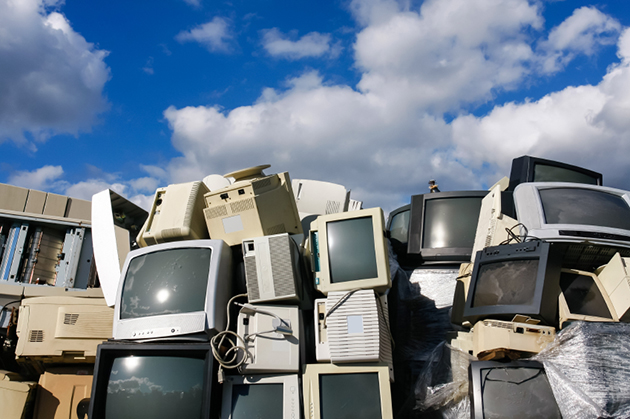
If you’re like me, you work from a home office and have plenty of devices supporting your work. You might also have a family with everything from laptops to phones, tablets to handheld gaming systems. Businesses have dozens or hundreds of devices, from server racks to computers, POS hardware to printers.
In my office alone, I have two monitors, a printer, a camera and microphone, a wireless keyboard and mouse, a phone, a speaker system, an air purifier, and all the remotes that go with some of it. Each one of those electronic devices contains valuable resources like copper, rare earth metals, lithium-ion or alkaline batteries, glass, plastic, silicon, etc.
Have you ever thought about the waste that’s generated when something breaks or stops working? Large businesses often discard tens of thousands of pounds of e-waste each year. Even a small business can dispose of hundreds of pounds. Estimates are that by 2030, we’ll be discarding 82 million tonnes (90.3 million U.S. tons) globally.
To build the electronics that replace the ones you’re discarding, raw materials like copper, gold, palladium, and silver are rapidly consumed. This requires open-pit mining and processing, all of which damage the land and create heavy emissions.
It’s also worth considering energy consumption, power plant and transportation emissions, and the impact on roadways from transporting those materials to manufacturers. Buildings are torn down to make way for new businesses and data centers. Old bridges are replaced with stronger, newer ones. All of this creates waste that is overloading municipal landfills.
We’ve reached a point where urban mining is essential for the circular economy. It’s no longer something to consider for the future. It’s past time to reduce the carbon footprint and depletion of metal supplies. Urban mining solves these issues and helps reduce the amount of waste going to overcrowded landfills.
What Is Urban Mining?
Traditional mining takes place somewhere in a state or country and involves heavy equipment digging into the ground to extract the metals or minerals. Urban mining shifts the extraction to a facility within a city or town.
Instead of electronic devices going to landfill, where they decompose over centuries, they go to a specialized processing plant where they’re broken down, parts are collected for reuse as much as possible, and the rest is returned in a form that can be reused.
Urban mining expands beyond electronics, too. Construction materials like cement supports from a bridge replacement and scrap metal are also ideal materials for urban mining.
How Does Urban Mining Reduce Waste?
Urban mining is key to reducing waste. While e-waste and electronics are a big part of it, there’s so much more. Consider all of these items that could be recycled and reused.
Electronics
- Aluminum – Found in device housings, frames, heat sinks, laptop housing, smartphone bodies, television components
- Cobalt – Found in rechargeable batteries
- Copper – Found in cables, chargers, circuit boards, motors, power supplies, transformers, and wires
- Gold – Found in circuit boards, connectors, high-performance components, and processor pins
- Lithium – Found in many rechargeable batteries
- Nickel – Found in rechargeable batteries and specialty components
- Palladium – Found in circuit boards, contact points, multi-layer ceramic capacitors, and specialized components
- Rare Earth Elements – Found in many electronics and larger items like EVs and wind turbines
- Silver – Found in circuit boards, conductive paste, contacts, and switches
- Steel – Found in appliance frames, computer cases, mounting hardware, server racks, and structural components
Data centers contain massive amounts of equipment, so the number of metals that can be collected as data centers upgrade equipment is substantial.
Construction and Demolition Debris
When a building, bridge, or other structure is torn down, the concrete, rebar, and steel used to go to industrial landfills. It’s better to send the materials to facilities that can reprocess them into aggregates.
Don’t Ignore the Benefits to the Environment
Urban mining offers several benefits for people and the environment. These are good reasons to recycle everything you can.
Limiting Groundwater and Soil Pollution
When E-waste ends up in a landfill, it’s hard to say what happens centuries from now. We know that it can take hundreds of years for metals to degrade. If you watch any metal detective videos, you see people finding coins dating back to the 1700s, and the coins are still solid.
Think of metals like cadmium, lead, and mercury leaching into the soil and groundwater. The HDPE and clay liners used today have only been in place for a few decades. It’s hard to tell exactly how long they will last, and many of us will be dead by the time it reaches that point.
When you embrace urban mining, the facility’s filtration systems handle those toxins.
Protecting the Land
Mining materials from the land does a lot of damage. Sometimes, the damage isn’t realized until decades later.
Since the 1980s, the EPA has named several Superfund sites that require careful, time-consuming cleanup to protect people and the environment from ongoing toxic pollutants. As of October 2026, about 1,900 Superfund sites still need cleanup.
A uranium mine in Wellpinit, Washington, opened in 1955 and closed in 1981. The drainage from that closed mine was found to contain high levels of heavy metals and radioactive materials. The cleanup process started in 2016 and is ongoing.
Reducing Energy Costs and Emissions
Recycling aluminum takes less energy than turning bauxite into aluminum. Recycling copper instead of extracting it reduces carbon emissions.
What Challenges Does Urban Mining Face?
The biggest problem facing a successful urban mining environment is consumer involvement. We all have electronics tucked away in drawers, attics, garages, basements, storage units, supply rooms, or closets. Each unused electronic could enter the recycling stream and be mined for essential metals and parts.
Some manufacturers glue components into place. When that happens, it’s difficult to separate the materials cleanly. Next-gen solutions like AI-powered mechanical sorting and disassembly speed up the process, but that equipment costs a lot of money and requires a lot of power.
It would help a lot if federal laws required manufacturers to build electronic devices that are modular and easy to upgrade, repair, and disassemble. Some states have enacted “Right to Repair” laws, but there’s still a lot of work to be done.”
How to Make Urban Mining Effective
If you’re a consumer, participate in community e-waste return events. Ask your town or city if they have any on the schedule, and urge community leaders to organize them if they don’t already. When you purchase new electronics, take advantage of takeback and trade-in offers. You may even get money back when you upgrade to a newer device.
Businesses must plan for electronic disposal before they even purchase items. Have your purchasing and IT departments work together to build a framework that ensures items are used as long as possible and recycled or refurbished by a certified ITAD provider when the time comes.
As tempting as it is to trade in a phone or tablet for something bigger and better a year later, wait it out. I’ve had laptops last 10 years before they simply wouldn’t go any farther. Save money and make them last as long as you can.
Both consumers and businesses can help by purchasing from companies that use as many recycled materials as possible. It may cost a little more at first, but the quality and reduced environmental impact make it worthwhile. Contact Urban Mining today!